
Mansfield, TX · Garage Door Service
What Mansfield's Garage Door Openers Are Up Against
Mansfield homes built mostly in the 1980s and 90s pair older openers with summer heat loads that strain circuit boards and backup batteries during outages.
- Repairs & new doors
- Springs & openers
- Serving 6 nearby communities
The Cost of This Job
We don't have a flat number to hand you here, because what an opener job costs depends on what's actually failed - a logic board, a capacitor, a dead battery backup, or the whole unit. What we can tell you is what drives the price up or down. A straight swap of the opener head on a bracket that's already in good shape is the cheapest version of this job. Add a fried circuit board from a surge, a stripped gear rail from years of heat cycling, or a safety sensor that's drifted out of alignment, and the job grows. Houses in this area run from 1959 up through 2014, with the bulk built in the 1980s and 90s, so a lot of what we find are chain-drive units from that window - some original, some replaced once already. Battery backup wasn't standard equipment on openers from that era, so adding one now is a separate line item, not a repair. If your opener still works fine on AC power and just loses lift during an outage, that's the honest gap: the unit was never built to run without the grid, and retrofitting it is worth pricing out before you replace the whole thing.
What Local Conditions Do
This area sits in a moderate-heat climate band, which doesn't sound dramatic next to places that get extreme summer warnings, but it still means long stretches where garage temperatures climb well above the house's conditioned air - especially in an attached garage under an asphalt-shingle roof, which is most of what got built here between 1959 and 2014. Heat doesn't break an opener outright. It shortens the life of the parts that already run hot: the motor capacitor, the circuit board solder joints, the gear set that drives the trolley. A board that's marginal in March can fail outright in August, and if that failure lines up with a grid outage, you're stuck with a door that won't open by motor or by battery, because the backup - if there even is one - has also been sitting in that heat degrading faster than its rated life. None of this is unique to one house. It's a function of age plus thermal load, and across a housing stock where the median build year is 1989, a lot of openers are well past the point where heat cycling has quietly worn them down.
What Is Going On
When the power goes out and the door won't budge, there are really only two things it can be: the opener has no backup power at all, or the backup power it has is dead. Openers installed before battery backup became common equipment - which covers a large share of the 1980s and 90s stock in this area - simply have no fallback. The motor runs on AC, the AC is gone, and the only way to move the door is the manual release and your own arms. Openers that do have a battery backup can still fail the same way if the battery's old; these batteries have a service life measured in a few years, not decades, and they don't announce they're dying until the moment you need them. On top of that, power outages are sometimes accompanied by a surge when service comes back on, and a surge through an unprotected opener circuit can take out the board even if the outage itself didn't touch the unit. That's a second, separate failure riding in on the first one, and it's why an opener that survived the outage can still be dead the next morning.
What to Check
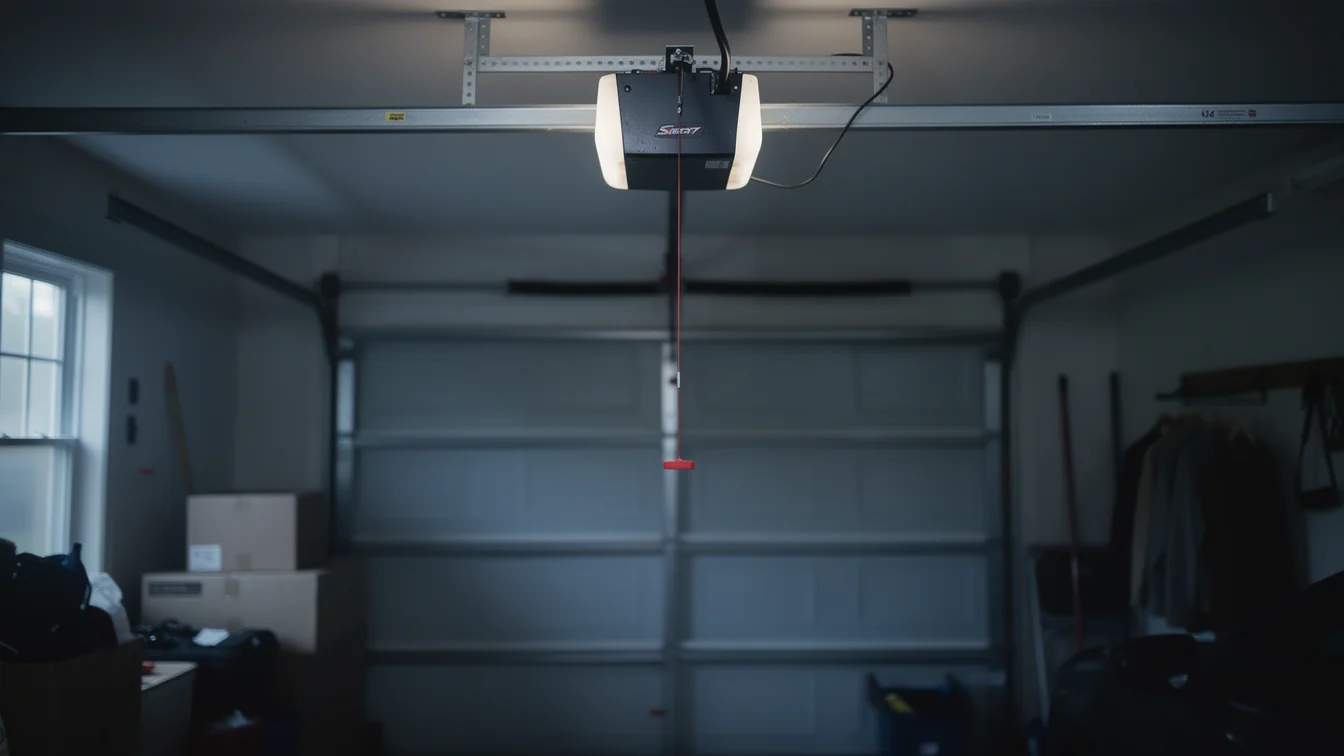
Start with the manual release cord - the red handle hanging from the trolley rail. Every opener has one, and knowing where it is before an outage matters more than any other single thing on this list. Next, if your opener has a battery backup, check the indicator light on the unit itself; most show a steady color when the battery is charged and a different one when it's failing or absent. If you don't know whether your unit has backup power at all, look at the install date against your opener's age - units from the 1980s and 90s typically don't, units installed in the last decade often do. After any outage, listen to the motor on the next normal-power cycle: grinding, hesitation, or a door that reverses partway can mean the surge did damage even though the lights came back on. We service this opener work across the wider Mansfield area, including homes out toward Rendon, Kennedale, and Venus, and the same housing-age pattern holds through most of that stretch. If the unit is original to a house built before the mid-90s, replacement is usually the better call than chasing a board repair on parts that are hard to source.
Frequently asked questions
Does my garage door opener need a battery backup if the power rarely goes out here?
It's worth having regardless of how often outages happen, because the failure mode is the same either way - you're locked out of using the motor until power's restored. Openers from the 1980s and 90s, which make up a lot of the stock in this area, typically shipped without one, so it's an add-on, not something to assume you already have.
Can heat really damage a garage door opener that isn't even running?
Yes. A garage under a shingle roof holds heat well above outdoor temperature for hours, and components like motor capacitors and board solder joints degrade faster the longer they sit hot, whether or not the door is cycling. In this area's moderate-heat climate, that slow wear adds up over the kind of 20-plus-year spans common in the local housing stock.
My door works fine on the wall switch after an outage but not with the remote. What's that?
That often points to a surge hitting the receiver circuit specifically rather than the whole board, which can happen when power comes back on unevenly after an outage. The wall switch may run on a different circuit path inside the unit. It's worth having it looked at rather than just living with the remote being dead.
Related garage door services in Mansfield
More garage door guides
Book garage door service in Mansfield
Call now or request a quote - tell us what the door is doing and where you are.